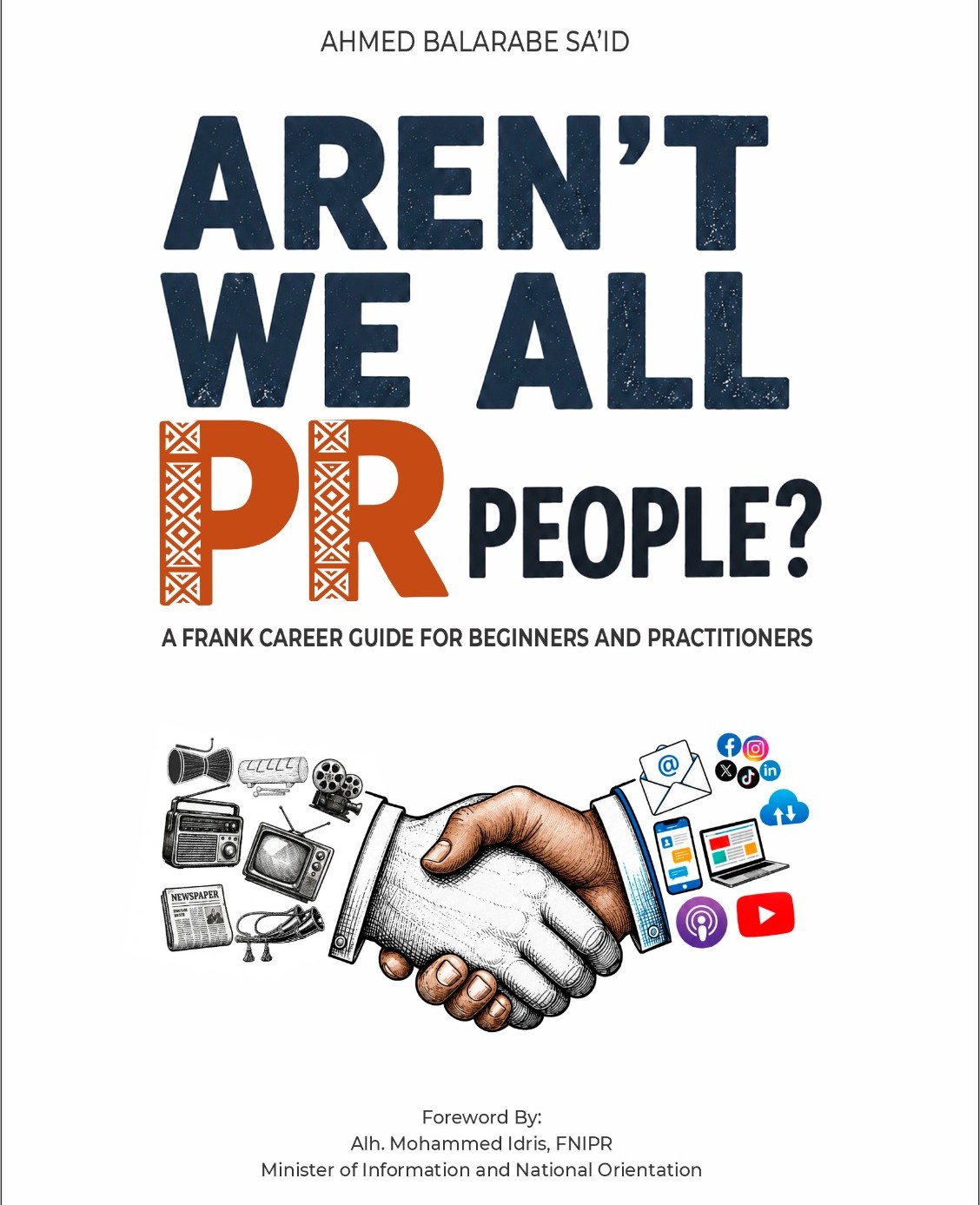
By Yushau A. Shuaib

MEMBERSHIP OF PROFESSIONAL BODIES

Academic qualifications and experience are basic requirements to practise in organised sectors. But in several other systems, membership of professional bodies is an added requirement mandatory for one to possess before being accepted to practise. Qualifying examinations are set by some bodies and years of service are also considered as prerequisite for full membership of some of these bodies. For instance, an intending practitioner must pass some examinations before becoming a chartered accountant. The institutes of Chartered Accountant of Nigeria (ICAN) and Association of National Accountants of Nigeria (ANAN) are the bodies registered by law to regulate the practice of accountancy in Nigeria. The Nigerian Institute of Public Relations too, has the same mandate on public relations practice in the country.


Apart from being a statutory authority to license practitioners and to sanitise the image of the profession, NIPR is empowered to make byelaws on accreditation of sectoral groups like Association of Corporate Affairs Managers of Banks (ACAMB) and Public Relations Consultants Association of Nigeria (PRCAN)


Aside enhancing one’s career and also being a basic requirement for employment in top positions in the field, other benefits of professional membership include the following:


Management Development: Knowledge is power which needs regular improvement on the trends and changes in managerial skills, especially in the face of advancement in technology. It is based on this that professional bodies organise training programmes for their members and interested public to broaden their scope of knowledge for optimum professional development.  It promotes and advances the standards of the profession and provides members with career development opportunities.  Some of the programmes include organised workshops, seminars, courses and conferences.


Publication: Informative materials are published and circulated to registered members to update them about happenings that are of relevance to the body and as practitioners. They keep them abreast of new developments and techniques in the profession and other related matters. Notable publications in this regard are newsletters, bulletins, journals, magazines and even books.


Job Opportunity: Many organisations that require the services of professionals always prefer to enquire from the body that regulates the profession which has a data bank containing the resume of its members who may be interested. The body therefore, creates job opportunities for its members by way of serving as referee to them.


Recognition: It acknowledges the contributions of members through the conferment of awards and fellowship and offers other special services to deserving members. It encourages and strengthens members to utilise their potentials in the field. It also provides the ultimate symbol of achievement and competence through the special abbreviation of membership after members’ names.


Special Discount: As a marketing strategy, some profit making organisations associate with the body by giving special discount to its registered members on their products and services. This is very popular in the developed countries where companies offer such discounts for car rentals, hotel rooms’ rates, postage service, restaurants and special credit card given to members.


Discipline: Members adhere strictly to the code of professional conducts which is a guide for observance of the high ethical standards.


Meeting Point: It affords members the opportunity of rubbing shoulders with professional colleagues and seniors and benefit from their vast experiences, ideas and views of veterans, especially on how to succeed. It is a melting point for healthy interaction.


CODE OF CONDUCT

As a system of moral principles and rules of behaviour, code of conduct is the totality of laws guiding members of any organisation for maximum ethical performance. It sets the expected and acceptable standards for members. The attitudes of the members and the philosophy of the profession are also set out in the Code of Conduct. It is based on the reputation and image that members create for their profession in discharging their duties that the publics form their opinion on the moral standing and their ability to deliver. Therefore the rules and regulations as stated in the Code are the principles of practitioners that govern or influence members’ character in their professional dealings. The Code stands as the regulator or gauge of members’ performances and promise of high standards of professional practice to the society.


From the foregoing, therefore, the Code is a set of laws or rules arranged in a system for the benefit of members on their day-to-day activities. Every profession, even associations, have guiding principles and regulations binding on their members, what is expected of them in their job and also their responsibilities to the society. The Codes, which are referred to as ethics of the profession, spell out the “dos” and “don’ts” for the practitioners.


The essence of the laid down principles is to further create goodwill and promote understanding between the practitioner and the public on one hand, and between the profession and the system operating in the society on the other hand. It projects its positive image as a reliable, responsible and supportive body. It also serves as security to its members, who may be victimised or unjustly treated in their professional calling.


The NIPR, like other related professional bodies, has its Code of Conducts that must be observed by all its registered members. Even though there may be similarities between its principles with those of other international bodies like the Institute of Public Relations, London, International Public Relations Association and public Relations Society of America, it is also unique for the fact that it is recognised by the law of Federal Republic of Nigeria.


Basically, the codes of professional conduct and ethical standards are formulated to guide members on their responsibilities to the following:


(a) Profession - It promotes the standing and the good character of the body. This is through the observance of all the positions of the body and its interest. Every association has a reason for its existence which includes protecting its integrity and credibility in its dealings and the control of its members through the rules and principles by which the body is governed. Adequate information dissemination towards a better-informed society is paramount in the profession, just as the observance of highest ethical standard and morality is cardinal duty for every member. Respect for the moral principles of the Universal Declaration of Human Rights and freedoms regularly features in most of the codes of public relations bodies. It is by adherence of the members to these that the reputation of the profession is guaranteed and promoted.


(b) Employer/colleague - The regulations charge the members on the best way and manner   to maintain loyalty and relate with the employers and clients who seek for their service, so that a mutual relationship exists where no one is at a disadvantage. Practitioners also should not be a threat to each other in the performance of their duties. The colleagues may be staff on other schedules or professional colleagues who may not be in the same environment. Maintaining high confidentiality with respect to secret documents is also vital. Disclosure of some privileged information could be criminal and make the culprit liable to prosecution. Members are therefore barred from such disclosure. Double-dealing which may be in conflict with the interest of the employer/client falls in this category unless with the employers/client’s expressed permission.


(c) The Public - This includes the general public and method of communicating with them. The officer is requested to observe civil, appropriate and acceptable norms in his interaction with the public. It also includes the media and other external public, including other professions. There is legislation against mistrust, betrayal of trust and lost of confidence. Members are enjoined to operate in conformity with the statutes while weighing the interest of the employers against that of the public when there is a conflict of interest before taking any action. The media who are the appropriate channel of communication should be treated with deserved respect and be fed with the truth avoiding distorted and wrong information which the profession abhors. Due respect must be given to others’ rights and views, for balanced assessment.

FEATURES OF ETHICAL STANDARDS

(a) Legality: It serves as a legal instrument which can be cited for settling disputes, resolving conflicts and also for sanctioning erring members who violate the codes. It is an enforcement apparatus on members. It derives its strength from legislative regulation in practice - that is in conformity with state laws.


(b) Simplicity: Even though it is intended for professional members, the language and style of its writing are devoid of legal and professional jargons. It is flawlessly written in the appropriate and understandable words, which is appealing and informative for the benefit of members and non-members alike. It is stated in such a way that it may not require further interpretation or details.


(c) Brevity: It is said that brevity is the soul of wit, so the code of the ethic does not run into volumes. It briefly covers all the dimensions of ethical norms of the profession. It is short and comprehensive with all the codes standardised in articles or charter for ease of reference.


(d) Adjustability: Like any law including the constitutions and decrees, they are flexible for ease of amendments whenever necessary due to societal changes. Apart from the Holy Scriptures which have divine inspirations, all man made laws are subjected to revision, amendment and improvement.


(e) Credibility: The Code of Conduct is a source of pride and legitimacy for its members. It creates goodwill and boosts the image of the body as a responsible, reliable and respectable organisation. Its credibility may be at stake if it is contradictory, self-centred, grammatically and factually inaccurate and lacking the authority for enforcement.


(f) Practicality: The rules should be such that members can abide by it and work within stipulated regulations without any difficulties.  Good rules that are not applicable or practicable may not see the light of the day and end up not being obeyed.


(g) Supportive: No matter how credible it is, it must serve the interest of the profession and its members at all times and also not be detrimental to other parties. It must nevertheless promote healthy competition where anybody can prove his/her worth.       


CONCLUSION

It is a known fact that the financial public relations is an essential part of management, which applies to the public and private sectors concerned. The purpose of the profession is to give adequate information on organisational activities, policies and plan of action. Its success and if necessary, reason for failure in the execution of programmes, can be well portrayed.  The policy makers, Chief Executives and other officers are wholly informed of the happenings around them through the monitor and review of media contents passed to them for proper and prompt response where necessary.


Enough facilities and tools should be provided for the public relations unit, which is a welcome administrative machinery of government, serving successive chief executives and administrations, irrespective of political or social differences.  The officer responsible should judiciously use the apparatus for protecting the reputation of his boss, more importantly the organisation, and avoid using the paraphernalia for cheap publicity and unwholesome propaganda.  Once the mission statement is stated clearly, best-suited programmes are required by the organisation at the establishment and maintenance of goodwill and understanding through regular contact with their customers, shareholders, boards of directors and employees, among others.  Maintaining their understanding must be supported with qualitative service, courteous habit and commendable social service. Those are the smooth ways of achieving prospect and profitability in the dynamic society and competitive market.


It is necessary, in view of the foregoing, to conclude that any organisation that intends to succeed in the business terrain and to assert its social standing, must apply the basic steps of solving public perceptions and attitudes. It should examine the prevailing situation through sampling and monitoring of public opinions and attitudes towards the organisation. Mapping out plans of action by adopting strategic programmes and workable method is an appropriate public relations skill of executing the communication process. Finally, seeking feedbacks could not be out of place at reassessing and evaluating the outcome of the executed programmes.